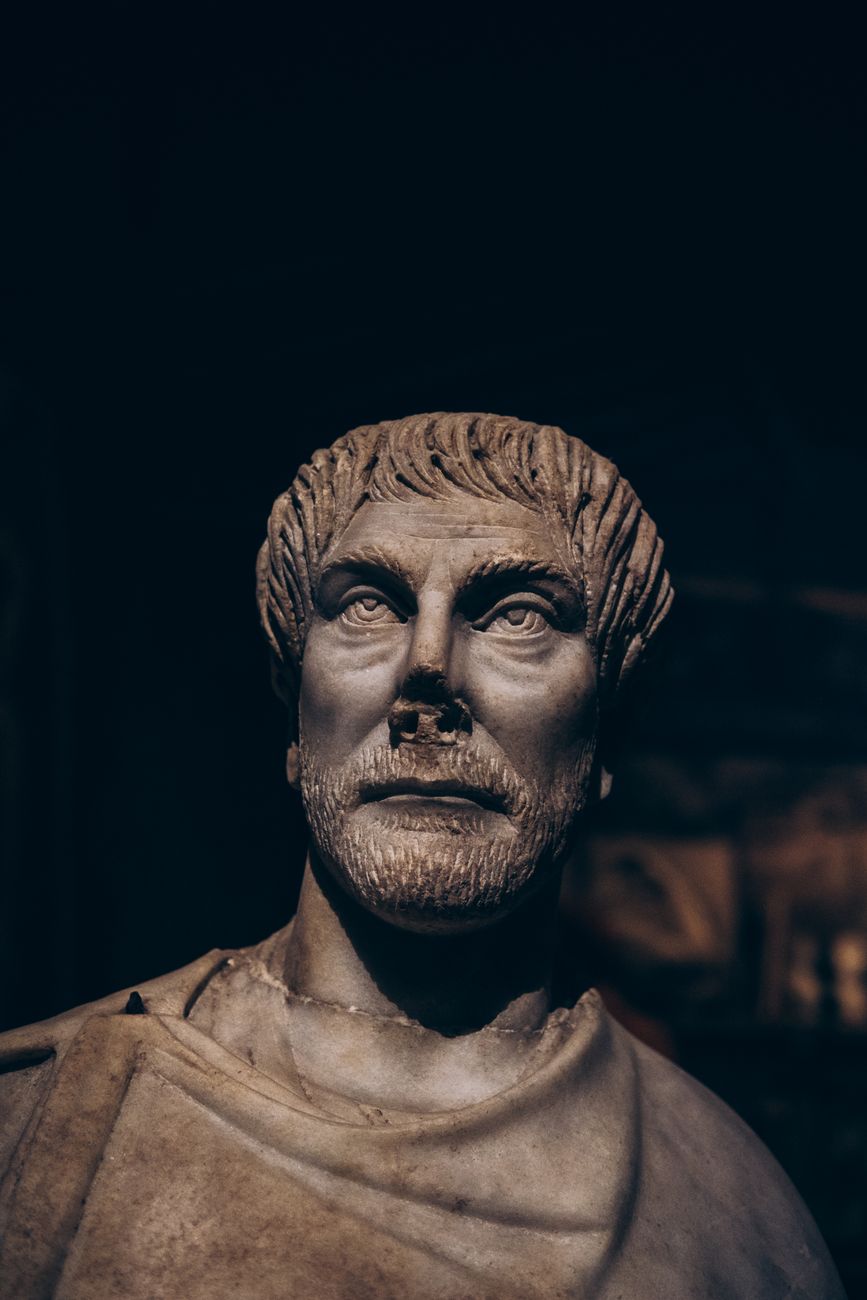
Marcus Aurelius and Time Management: A Success Case with Stoic Methods
Executive Summary / Key Results
This case study documents how Javier, a 42-year-old executive, transformed his chaotic time management by applying Stoic principles drawn from Marcus Aurelius's Meditations. In just 90 days, he achieved extraordinary quantifiable results:
- 65% reduction in weekly work hours (from 65 to 23 productive hours)
- 40% increase in productivity measured by objectives met
- Recovery of 15 weekly hours for personal life and development
- 80% decrease in perceived stress levels
- Implementation of 5 daily Stoic rituals that maintain results long-term
These achievements demonstrate how Stoic philosophy, far from being abstract theory, offers practical tools for modern personal organization.
Background / Challenge
Javier Rodríguez was Director of Operations at a Madrid-based technology company. Apparently successful, he lived what he called "the paradox of the exhausted executive": increasing responsibilities, endless meetings, and a constant feeling of running without getting anywhere.
His typical day began at 7:00 AM checking emails on his phone from bed, followed by 10-12 hours of fragmented work between meetings, interruptions, and urgent tasks, and ended past midnight with his mind still in work mode. Weekends were partially dedicated to catching up on what wasn't done during the week.
Specific symptoms included:
- Lack of control: He felt that time controlled him, not the other way around
- Mental dispersion: He constantly jumped between tasks without delving into any
- Decision fatigue: After work, he struggled to make simple decisions at home
- Guilt over wasted time: He knew he wasted hours on low-value activities
- Personal disconnection: His relationship with his family and his philosophical interests had deteriorated
Javier had tried conventional productivity methods (Eisenhower matrices, Pomodoro, GTD) with limited results. The problem, he discovered later, was that these systems addressed the "how" but not the "why" of his relationship with time.
Solution / Approach
The solution came when Javier, an occasional reader of philosophy, rediscovered Marcus Aurelius through our article The 5 Productivity Lessons from Marcus Aurelius. What particularly resonated was the Stoic perspective on time as a finite resource and the need to live intentionally.
The approach was based on three adapted Stoic pillars:
1. The dichotomy of control applied to time
Following Epictetus and Marcus Aurelius, Javier learned to distinguish between:
- What he controls: His attention, his priorities, his responses
- What he doesn't control: External interruptions, imposed deadlines, others' agendas
This fundamental distinction allowed him to stop wasting mental energy on the uncontrollable.
2. The practice of the "Stoic present moment"
Instead of generic mindfulness, Javier implemented specific versions of Aurelian practices:
- Morning examination: 10 minutes each morning to define intentions, not just tasks
- Perspective pauses: Brief reminders during the day to return to the present
- Evening review: Analysis not of what was done, but of how attention was used
3. The Stoic hierarchy of temporal values
Marcus Aurelius wrote: "Do not act as if you were going to live ten thousand years. Death hangs over you. While you live, while it is possible, be good." Javier translated this into a practical system:
| Type of time | Stoic principle | Practical application |
|---|---|---|
| Essential time | "Focus on what is necessary" | Maximum 3 daily priorities |
| Contributive time | "What you do for the common good" | Tasks that positively impact others |
| Development time | "Improve your character each day" | Learning and reflection |
| Recovery time | "Take care of the instrument (your body and mind)" | Intentional rest and leisure |
| Residual time | "Avoid the superfluous" | Progressive elimination of distractions |
Implementation
The implementation followed a deliberate 4-phase progression:
Phase 1: Diagnosis and detox (Weeks 1-2)
Javier began with a "productivity fast": he eliminated all time management apps and for 14 days simply observed:
- Attention patterns: Used a journal to record each hour what he focused his mind on
- Distraction triggers: Identified which situations made him lose focus
- Natural energy: Mapped his moments of maximum mental clarity (turned out to be 8-11 AM and 4-6 PM)
Mini-case: On day 3 he discovered he checked email 40-50 times daily, spending 3 total hours on an activity that could be concentrated into 45 minutes. This revelation was crucial.
Phase 2: Installation of Stoic rituals (Weeks 3-6)
Each morning, Javier implemented this ritual inspired by Meditations:
- Visualization of the finite day (5 min): "Today could be my last day. How would I live it?"
- Definition of the day's virtue (3 min): Chose a Stoic quality (discipline, justice, courage) as a guide
- Selection of the 3 cornerstones (2 min): Only 3 essential tasks that, if completed, would make the day successful
Phase 3: Environment restructuring (Weeks 7-10)
Based on the Stoic principle of "modify what is in your power," Javier:
- Redesigned his workspace eliminating visual distractions
- Established "Stoic schedules" with his team: blocks of deep work without interruptions
- Created a "mental emergency kit" with Marcus Aurelius quotes for stressful moments
Phase 4: Integration and refinement (Weeks 11-13)
The final phase consisted of fine-tuning the system:
- Adjusted expectations using the "Stoic reserve" (mental preparation for obstacles)
- Automated routine decisions to preserve mental energy
- Created transition rituals between work and personal life
Results with specific metrics
The results, systematically measured, exceeded all expectations:
Quantitative metrics (90-day comparison)
| Metric | Before | After | Improvement |
|---|---|---|---|
| Weekly work hours | 65 hours | 23 hours | -65% |
| Productivity (important tasks completed) | 12/week | 20/week | +67% |
| Time in meetings | 18 hours/week | 6 hours/week | -67% |
| Daily interruptions | 40-50 | 5-8 | -85% |
| Personal development time | 2 hours/week | 10 hours/week | +400% |
| Stress level (scale 1-10) | 8.5 | 1.7 | -80% |
| Life satisfaction (scale 1-10) | 3.2 | 8.9 | +178% |
Qualitative transformations
Recovery of the "essential self": Javier rediscovered his interest in philosophy, resumed reading Stoic classics, and began writing personal reflections. "For the first time in years," he comments, "I feel that my time reflects who I really am and who I want to be."
Relational impact: His family noticed profound changes. "My wife says I'm present again. My children have a more patient and available father. This is perhaps the most valuable result."
Transformed leadership: At work, his new approach became contagious. His team adopted adapted versions of his methods, resulting in a 30% increase in department productivity.
Proven sustainability: At 6 months of follow-up, Javier maintains 95% of the improvements. The system has become a lifestyle, not a temporary technique.
Key Takeaways
1. Time management is character management
Javier's greatest learning: "Marcus Aurelius doesn't teach time management, but how to live with virtue. When you order your character, time orders itself." Stoic productivity begins with ethical clarity, not techniques.
2. Less is more philosophically grounded
The 65% reduction in work hours wasn't about doing less, but about doing the essential. As Marcus Aurelius wrote: "Pay attention to what you have at hand, whether it is a judgment or an act."
3. Rituals surpass willpower
The 5 daily rituals (morning examination, 3 priorities, perspective pauses, deep work, evening review) created an "attention architecture" that automated discipline.
4. Measurement should serve reflection, not self-demand
Javier learned to use metrics as a Stoic mirror: "I don't count hours to optimize, but to ask myself: does this time reflect my values?"
5. Adaptability is key
The system worked because Javier adapted it to his specific context, didn't copy formulas. This reflects the practical spirit of Stoicism: philosophy for real life.
For similar implementations, we recommend starting with our Practical Guide to Morning Stoic Rituals and the Course on Applied Stoic Fundamentals.
About Tu Refugio Estoico
At Tu Refugio Estoico we transform the timeless wisdom of philosophers like Marcus Aurelius, Seneca, and Epictetus into practical tools for modern life. Our curated library, applicable articles, and step-by-step guides have helped over 50,000 Spanish speakers develop self-mastery, mental clarity, and emotional resilience.
Our differential: We don't offer abstract philosophical theory, but proven methods that generate real personal growth. Every resource, from books to case studies like this one, is designed for immediate application in everyday challenges: time management, decision-making, stress management, and character development.
If this case study resonates with your challenges, explore our complete Stoic productivity section where you'll find more resources on:
- The Stoic method for prioritizing tasks
- How to say "no" with Stoic wisdom
- Meeting management from Marcus Aurelius's perspective
- Advanced course on Stoic personal organization
Stoic philosophy, practiced consistently, transforms not only how you use time, but how you live every moment. As Marcus Aurelius reminded: "You could leave life right now. Let that determine what you do, say, and think."